

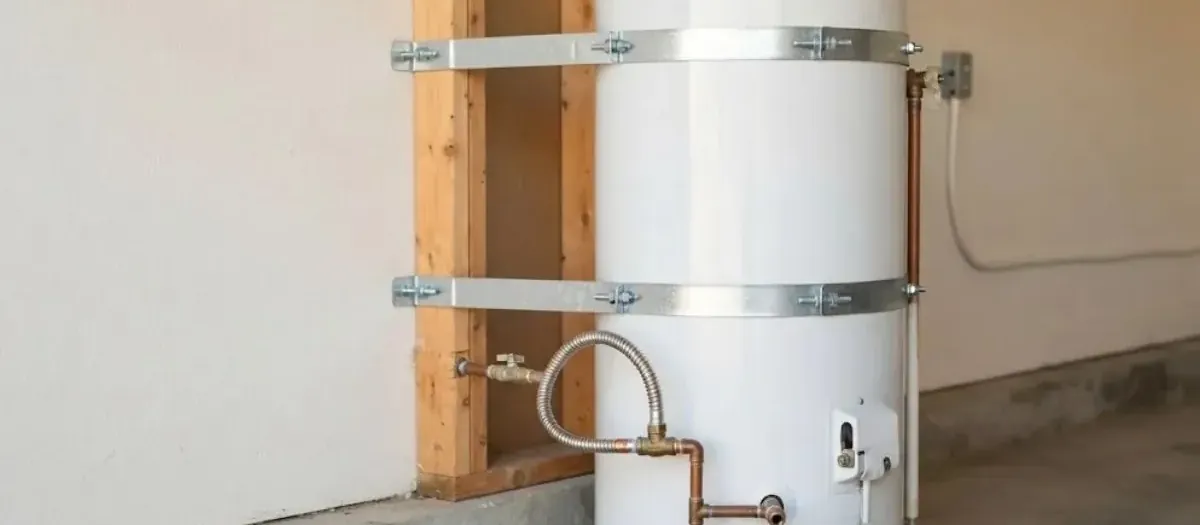
An expansion tank belongs on the cold water supply line, close to the water heater, usually just after the shutoff valve and before any branch. In Forest Grove, as anywhere, it absorbs the extra volume that heated water creates, so pressure in a closed system does not spike. Placement, support and the air charge inside the tank all matter.
This guide explains what the tank does, why a closed plumbing system needs one, how to think about vertical versus horizontal mounting, what the relief valve has to do with it, and what cost guides report. If your heater is being replaced, call (503) 974-3329 and we will cover the tank in the price before work starts.
What the Tank Does Inside Your Plumbing
Water expands when it heats. A fifty-gallon heater that warms a full tank pushes out a measurable amount of extra water. In an open system that water backs up into the city main and nobody notices. In a closed system it has nowhere to go, so pressure climbs.
The expansion tank gives it somewhere to go. Inside is a rubber diaphragm or bladder with a cushion of air on one side. As pressure rises, the water pushes into the tank and compresses that air. When the heater cycles off and the water cools, the air pushes it back out.
Without that cushion, the heater's pressure relief valve may start releasing water. Repeated pressure spikes also stress fixtures, supply connectors and the heater itself, which is why the tank is a small, cheap part that protects expensive ones.
How a System Becomes Closed
A system becomes closed when something stops water from flowing backward toward the street. That can be a check valve, a backflow preventer or a pressure reducing valve with a built-in check. Many homes have one without the owner knowing.
This is easy to miss. A house with no expansion tank for twenty years may suddenly start dripping from the relief valve after a plumbing change or a new device on the line.
Signs to watch for include a relief valve that drips, water hammer that shakes the pipes when the heater fires, and faucets that weep. According to EPA WaterSense, ideal home pressure runs 45 to 60 psi, and a simple pressure gauge on a hose bibb will show you the number.
Where on the Pipe the Tank Goes
The tank connects to the cold water supply, on the pipe feeding the heater. A tee fitting goes in between the cold shutoff valve and the heater's cold inlet, and the tank hangs off the tee. Mount it as close to the heater as space allows, so the heated water has the shortest trip to reach it.
Keep it off the hot side unless the manufacturer's directions say otherwise. Putting the tee after the shutoff valve also lets you close the valve and work on the tank without draining the house.
| Check | Why it matters |
|---|---|
| Cold supply line, near the heater. | Keeps the tank in the path of the expanding water. |
| After the shutoff valve. | Lets the tank be isolated and serviced. |
| Not on the hot side. | Protects the diaphragm from constant hot water. |
| Clear of the relief valve discharge. | Keeps the pipe path open and the tank dry. |
| Accessible for pressure checks. | The air charge needs to be tested over time. |
Not sure whether your heater has a tank, or where it should go? Call and a plumber can check the setup.
Call (503) 974-3329Hanging It Vertically or Supporting It Sideways
Expansion tanks range from a small canister to a larger cylinder. Weight is the concern, because a full tank hanging off a pipe fitting puts stress on the joint.
In general terms, a small tank can hang from the pipe in the upright position with the connection at the top, while a heavier tank needs a bracket or strap that carries part of the load. A horizontal tank almost always needs its own support. Read the installation sheet for your tank, because the rules vary by model.
The air valve on the tank also needs to stay reachable. If the valve is tucked behind the heater or against a wall, the plumber cannot check the charge during later service.
Setting the Air Charge Correctly
A new tank usually ships with a factory air charge. That charge must match the pressure in your supply line. A tank set too low fills with water and goes soft. A tank set too high will not take any expansion at all. Both leave you with the original problem.
- Close the cold shutoff and relieve pressure at a nearby faucet.
- Check the tank's air charge at its valve with a tire gauge.
- Compare it to the house pressure measured at a hose bibb.
- Add or release air so the two numbers match.
- Open the shutoff and check for leaks at the new fittings.
A tank that feels heavy, or that squirts water when you press the air valve, has failed. The diaphragm has split. Replace the tank rather than trying to refill it. A tank that only lost air, with no water at the valve, can often be recharged to match the line pressure.
The Relief Valve and Its Discharge Pipe
The temperature and pressure relief valve is the heater's last line of defense. If pressure or temperature exceeds a safe limit, it opens and sends water down a discharge pipe. EPA WaterSense says to check that valve at least once a year, and DOE guidance suggests every six months, so you know it moves.
The Oregon Building Codes Division treats thermal expansion protection and relief valve termination as code items when a water heater is replaced. That means the discharge pipe has to end in a safe place, and the system has to deal with expansion. Do not cap the discharge pipe or plug the valve to stop a drip.
A relief valve that drips on every heating cycle is often reporting thermal expansion, and a new or replaced tank can stop it. One that drips constantly may be failing. If yours is dripping now, call (503) 974-3329.
Cost and Permit Facts
Angi reports an average of $325 ($150 to $450) to install an expansion tank. If the tank goes in with a new heater, the cost is folded into the installation. If your pressure is too high, a pressure reducing valve may be the real issue, and Angi puts a PRV replacement at an average of $400 ($200 to $700).
| Item | Reported figure |
|---|---|
| Expansion tank installed | Average $325 ($150 to $450) per Angi. |
| Pressure reducing valve replacement. | Average $400 ($200 to $700, Angi). |
| Tank water heater installed. | $882 to $1,826 (Angi) or $600 to $3,100 (HomeGuide). |
A water heater replacement needs a permit in Forest Grove, and thermal expansion protection is one of the code items that apply when a heater is replaced. Permits come from Community Development at 503-992-3229. Oregon also expects water heaters to be anchored or strapped. See our water heater replacement and water heater repair pages for what a job covers.
Forest Grove Note: Pressure, Permits and Nearby Towns
Forest Grove runs a City-owned water utility, and permits for plumbing work come from the Community Development office at 1924 Council St. Cornelius contracts its building services from the Forest Grove Building Division, so a water heater swap in Cornelius goes through the same office. Cornelius also runs a backflow testing program, and a backflow device on a line is one way a system becomes closed.
In North Plains, the city notes that backflow devices on irrigation and boilers must be tested at installation, yearly and after any repair. Building and plumbing permits there are handled by Washington County, not by Forest Grove.