

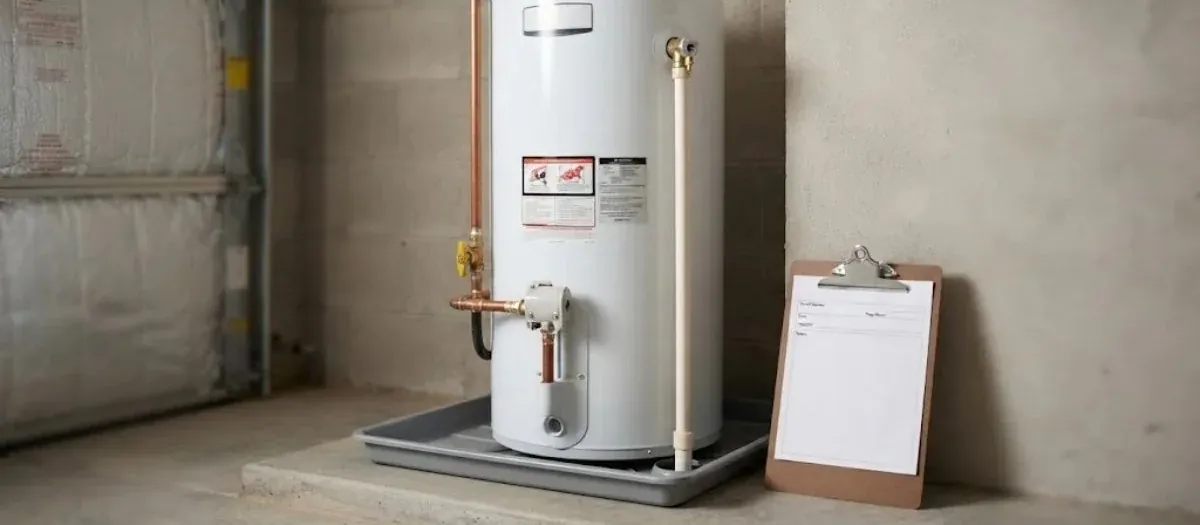
When a tank gives out, it rarely does it politely. You find a puddle in the closet, a damp ring on the garage floor, or a stream running from the base. We dispatch licensed plumbers 24/7 for exactly this. Right now, shut off the power or gas control, close the cold water valve on top of the tank, and move anything valuable out of the wet area.
Once the old tank is drained and out, the new one has to be sized, vented, strapped and permitted. That is where a rushed job goes wrong. Call (503) 974-3329 and we will talk through what you have and what a same-day visit can cover when one is available. Homes in Hillsboro follow that city's own permit office, so tell us the address.
Leaking From the Bottom Tonight
If the tank is leaking and you cannot stop the water, close the main shutoff valve where the pipe enters your house. Do not close the valve at the city meter. Forest Grove's rule is that customers never touch it, and if the meter or line breaks, the repair is on the homeowner. If the main will not turn, call Public Works at 503-992-3258.
A steady weep at the bottom edge is the classic sign of a rusted-through shell. If the water comes from the shell, the tank is done. Buckets and a wet vacuum buy time, but they do not fix a steel tank. If a gas heater is involved and you smell gas at any point, leave and call NW Natural at 800-882-3377 or 911 from outside.
Why a Leaking Tank Gets Replaced, Not Patched
Inside a storage tank, a glass-lined steel shell holds the water. Over time the lining cracks, the steel corrodes, and the sacrificial anode rod (a metal rod that rusts first, to protect the tank) wears away. Once water escapes through the shell, nothing outside the tank can seal it. Leaks at fittings and valves are different and often fixable by repairing the heater instead, which is why we look before we recommend anything.
The U.S. Department of Energy puts a storage water heater's life at roughly 10 to 15 years. In Forest Grove, the median home was built in 1982 and about 48 percent of homes date before 1980, so a home of that age may have old shutoffs and fittings that need replacing at the same time.
| Situation | Replace now? | Why |
|---|---|---|
| Water leaking from the shell. | Yes | Corrosion cannot be repaired. |
| Tank over 12 years old, no hot water. | Usually | A repair buys little time. |
| Fitting or valve leaking, tank dry. | Often not | The part can be swapped. |
| Rust-colored hot water only. | Check first | Could be the anode rod or old pipe. |
| Heater under 8 years old with one failed part. | Usually repair | The tank is still sound. |
Water on the floor? Call now and a licensed plumber will talk through your next steps.
Call (503) 974-3329The Permit, the Straps and the Relief Pipe
In Oregon, replacing a water heater needs a plumbing permit, and the person doing the work gets it. For Forest Grove addresses that means the City of Forest Grove Community Development office on Council Street, phone 503-992-3229. A permit lapses if work does not start within 180 days. Gas piping and the flue also need a mechanical permit.
Three items are code issues whenever a heater is replaced. The tank has to be anchored or strapped against movement, under the Oregon Plumbing Specialty Code. Thermal expansion protection has to be addressed, and the relief valve discharge has to terminate properly. Anyone, homeowner included, who works on LP gas piping or appliances must be licensed. Details like these are why the permit and inspection matter.
Expansion Tanks and Why Closed Systems Need Them
Heating water makes it expand. In a house with a check valve or pressure regulator on the supply, that extra volume has nowhere to go, so pressure spikes every time the burner or element runs. A small expansion tank on the cold line absorbs it. Without one, the relief valve may drip and fittings wear out early.
Cost guides such as Angi put an expansion tank at about $325 on average, with a range of $150 to $450. If your current heater never had one, the new one will probably need one to meet code. We tell you that up front, not as a surprise on the invoice.
Gas Replacement Tanks
Swapping gas for gas is the simplest path when the venting and gas line are sound. The plumber disconnects the gas supply and flue, sets the new tank, checks the draft and tests every joint. A planned installation covers the same ground at a calmer pace, which matters if you want to move the heater or change its size.
The flue gets checked for slope, size and condition, not just reused. If a tankless unit appeals, it needs a bigger venting and gas line review, covered on our tankless water heater page.
Electric Replacement Tanks
An electric tank swap is mostly about the 240-volt circuit and the water connections. The plumber confirms the wire gauge and breaker match the new heater's label, flushes the lines, and fills the tank before power goes on. Turning an element on dry burns it out in seconds, so filling comes first.
If a breaker or panel looks wrong, that is an electrician's job, and we say so plainly. For a power outage on the street side, Forest Grove Light & Power is city-owned and reachable at 503-992-3250.
Heat Pump Water Heaters and Rebates
A heat pump water heater, sometimes called hybrid, pulls warmth from the surrounding air to heat water. It needs open space around it, a condensate drain, and a room that can spare some heat. It costs more up front and typically uses much less energy to run. Energy Trust lists $1,200 for heat pump water heaters through retailers and distributors at energytrust.org/water.
For gas, NW Natural and Energy Trust offer a $400 cash incentive for replacing a natural gas tank heater with a qualifying gas tankless, with an offer end date of January 31, 2027. The number is 503-220-2360. Programs change, so check current terms before you buy. Ask about eligibility before the old tank leaves.
What Replacement Costs and Why
Cost guides report an installed standard tank at roughly $600 to $3,100 (HomeGuide) or $882 to $1,826 (Angi), and a heat pump unit at about $2,000 to $4,600 (HomeGuide). Those are guide figures, not our price. You get a clear price before work starts.
Fuel and type
Gas, electric and heat pump units differ widely in equipment cost, and so does the work around them.
Tank size
A larger tank costs more and may need a longer venting run or a new base.
Code upgrades
Straps, an expansion tank, a corrected relief pipe and the permit are all part of the job.
Location
An attic, a crawlspace or a tight closet takes more time than a garage.
Old fittings
Corroded valves and connectors on older homes are often replaced at the same time.
Insurance may cover water damage from a sudden tank failure but usually not the tank. Keep photos, a receipt and the old tank's label. Ask your insurer before you discard anything they may want to see.
To price your heater, call (503) 974-3329 and describe what you have now.
Ready to swap the tank? Call and we will arrange a same-day visit when one is available.
Call (503) 974-3329