

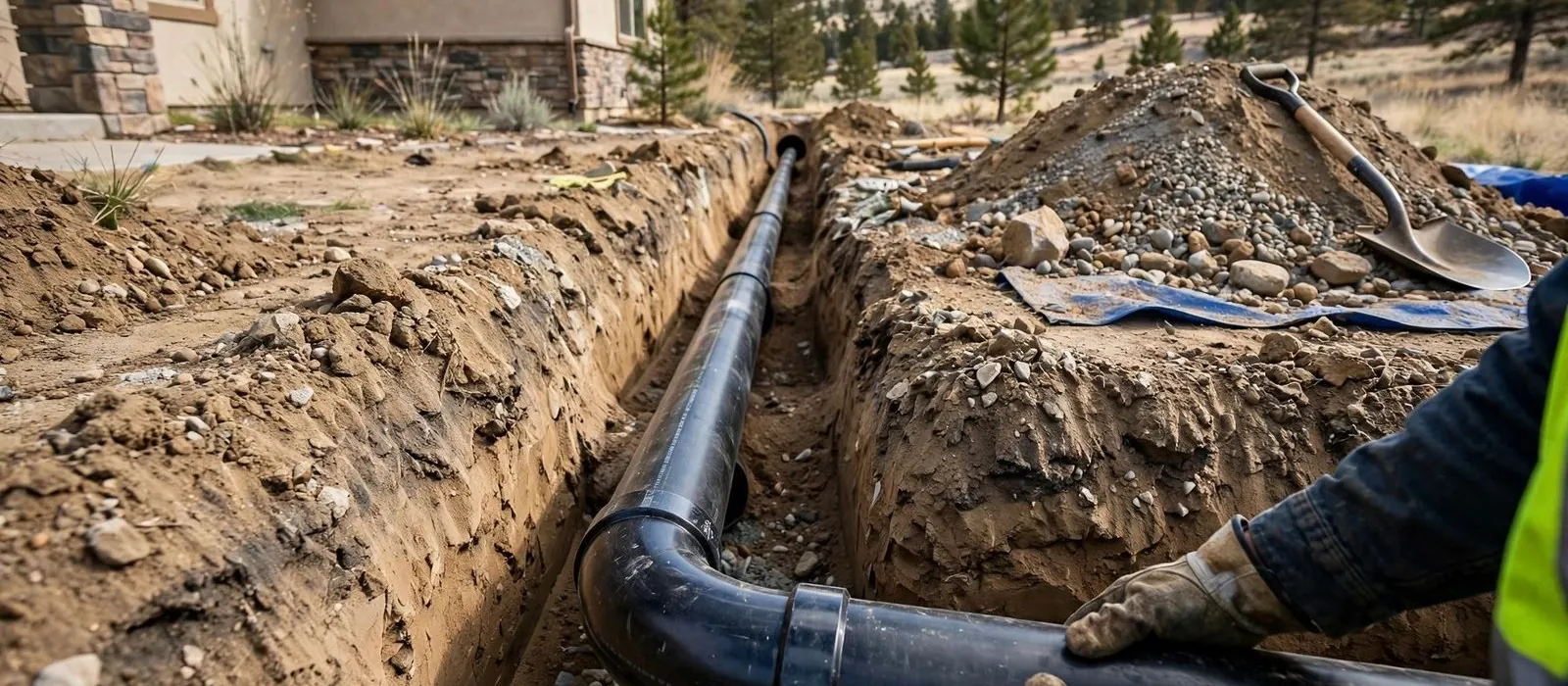
A sewer pipe that has cracked, shifted or collapsed shows itself fast: repeated backups, a gurgling toilet, a wet or sunken patch in the yard, a smell outdoors. If sewage is coming into the house, treat it as an emergency, stop using all water, keep people out of the wet area, and call (503) 974-3329. Our 24/7 dispatch sends a licensed plumber and you get a clear price before work starts.
Repair costs more than cleaning, so it pays to understand the choices. You will see how pipe material relates to the age of a house, what happens inside cast iron over decades, how spot repair, trenchless work and full replacement compare, and where permits and Clean Water Services fit in.
Emergency Signs the Pipe Itself Has Failed
A clog is something in the pipe. A failure is something wrong with the pipe, and no cleaning fixes it. Typical signs are backups that return within weeks of a cleaning, a camera showing a cracked wall or missing section, and soil or roots visible inside the pipe.
Outdoors you may see a dip over the line, a lawn patch that stays soggy in dry weather, or a smell near the cleanout. Indoors, floor drains may gurgle when the washer runs. A sewer camera inspection shows the real condition before anyone talks about digging. Dispatch covers nights and weekends.
Pipe Material and the Age of the House
Pipe tells a story about the decade it went in. In much of the country, clay tile and cast iron served the oldest houses, bituminized fiber pipe often called Orangeburg turned up in postwar decades, and plastic such as ABS or PVC became the norm from the 1970s. Repairs and additions mix materials, so houses vary.
Forest Grove has plenty of older housing. About 1,030 homes date to 1939 or earlier, 298 to the 1940s, 696 to the 1950s and 766 to the 1960s. About 48 percent were built before 1980, though the median year is 1982. A build date cannot tell us what is under your yard. A camera can.
| Material | Common weak point | What a camera shows |
|---|---|---|
| Clay tile | Joints that open, roots. | Offsets, root masses at seams. |
| Cast iron | Rust scale, corrosion at the bottom. | Rough walls, flaking, thin spots. |
| Fiber (Orangeburg) | Softening, ovaling, collapse | Flattened or egg-shaped section. |
Repeat backups and no clear cause? Call and ask for a camera look at the line.
Call (503) 974-3329Cast Iron: How It Fails From the Inside
Cast iron is heavy, quiet and long-lived, which is why it served as building drain for so long. It rarely fails from the outside. Waste gases and moisture work on the lower half of the pipe for decades, forming rough rust scale that narrows the bore and catches paper and grease.
A cast iron line that backs up repeatedly may be scaled rather than clogged. Scale can flake off in plates, and the wall beneath can be thin. A plumber looks for cracks along the bottom, rust weeping at hub joints and sagging sections. Often the answer is replacing the worst section, or all of it, with plastic pipe.
If the camera shows scale but sound metal, jetting the pipe can buy time, and our page on cleaning the main line covers the trade-offs.
Spot Repair, Trenchless or Full Replacement
Spot repair means digging down to one damaged section, cutting it out and joining new pipe. It suits a single crack or a root-damaged joint with sound pipe on both sides. Trenchless work reaches the pipe from two small access pits. Lining pulls a resin sleeve inside the old pipe, while pipe bursting pulls new pipe through as the old one is broken apart. Full replacement means an open trench along the whole run.
| Option | Fits when | Watch for |
|---|---|---|
| Spot repair | One damaged section, rest is sound. | Next failure may be a few feet away. |
| Lining | Cracks and joints, but pipe still round. | Little help if the pipe is crushed or has a deep belly. |
| Pipe bursting | Old pipe is badly damaged but in a straight run. | Needs access pits and clear routing. |
| Open trench replacement | Collapsed, badly bellied or mixed-material line. | Yard, driveway and landscaping disruption. |
Which option is right depends on what the camera shows, how much of the line is bad and what sits on top of it. A mature tree, driveway or retaining wall can favor trenchless. A deep belly usually requires digging so the slope can be reset.
Defects in the Public Right of Way and Clean Water Services
Your lateral belongs to you under City Ordinance 52.03, but part of it may sit under the street or in an easement. Clean Water Services may repair structural defects in a lateral where they occur in the public right of way, such as cracked pipe, open or offset joints and root intrusion.
A sag, also called a belly, is not a structural defect. If the camera finds a defect near the street, the plumber, owner or realtor can send the video to CWS Field Operations at 503-547-8100. Do that before paying for work CWS might cover. Cornelius is set up differently, with the city maintaining the main and CWS treating the sewage, so ask who handles a defect there.
Permits, Locates and the Paperwork Behind a Dig
Building sewer and water service work needs a permit in Oregon, and whoever does the work, homeowner or contractor, applies for it. In Forest Grove, Community Development at 1924 Council St issues plumbing permits, phone 503-992-3229. Lateral work may also need an erosion control permit. Replacing the water side is a separate job, covered under water service line repair.
Call 811 before any digging so underground lines are marked. Permits lapse after 180 days if work has not begun. Cornelius contracts building services from the Forest Grove Building Division, while Hillsboro issues its own plumbing permits, so confirm which office applies.
Sewer Repair Cost Ranges and What Drives Them
Angi reports an average spot repair near $2,600 with most between $1,100 and $4,100. Full replacement by digging runs $50 to $250 per foot, trenchless $60 to $250 per foot and pipe lining $80 to $250 per foot. For Portland, Angi's sewer replacement average is $3,681 ($1,937 to $5,425). These are guide numbers, not a bid.
Length of pipe affected
Per-foot pricing means a long run costs far more than a short patch.
Depth and soil
Deeper pipe needs shoring and more hauling.
Surface above the pipe
Concrete, pavers and mature roots add cost and may change the method.
Permits and locates
Permit fees and inspection scheduling are part of the total.
Standard homeowners policies often exclude wear and root damage on sewer pipe. Some insurers sell a service line add-on, so ask yours. Keep the camera recording because adjusters may want to see it.
Call (503) 974-3329 and a dispatcher will explain the steps, and a clear price is given before work begins.
Questions to Ask Before You Approve a Dig
Ask to see the video, with distance markers if possible. Ask what the plumber will do if the dig finds worse pipe than the camera showed, and which permits will be pulled and by whom. You can check a contractor on the Oregon CCB license search and a plumber on the BCD license search before anyone starts. Calling (503) 974-3329 with those questions is a fair way to compare. Same-day appointments are possible when the schedule allows.
Camera found damage and you want a plain plan? Call and talk it through.
Call (503) 974-3329