

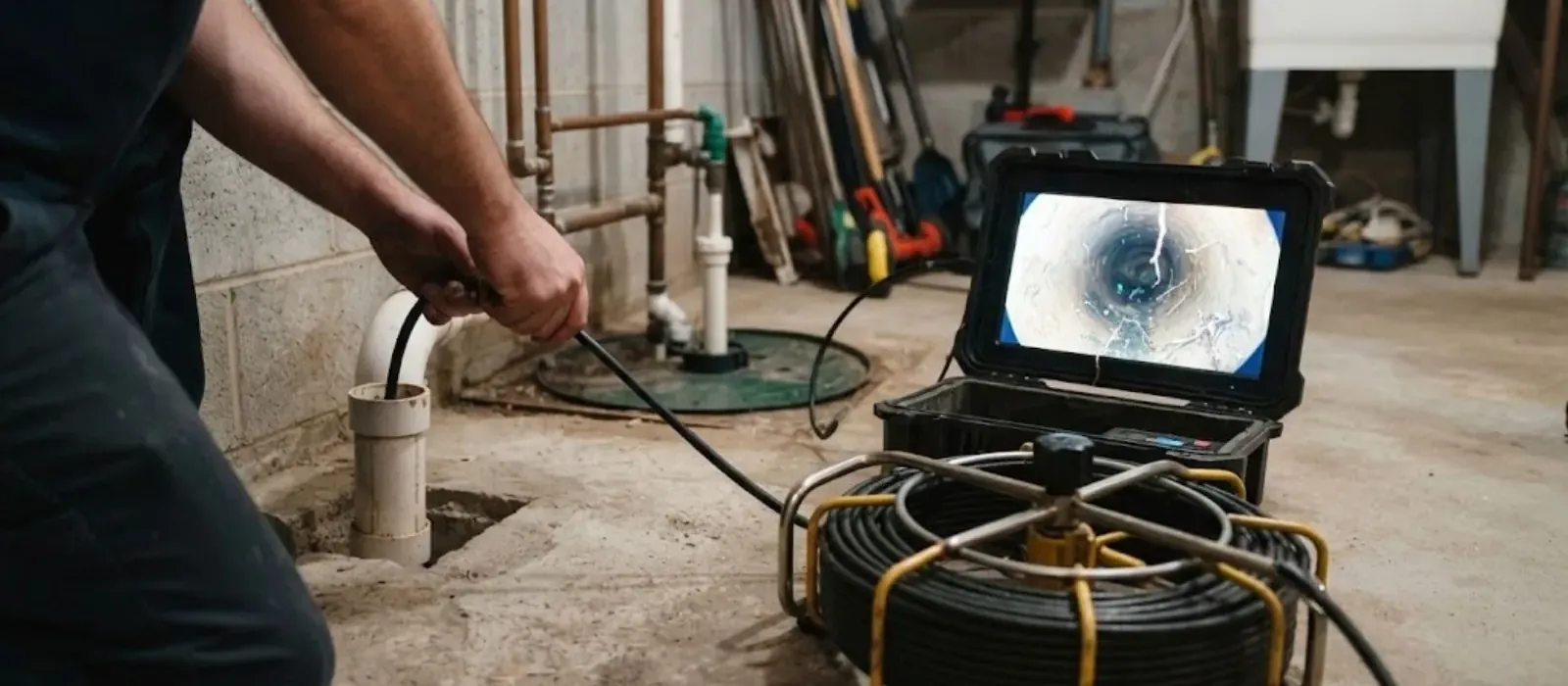
Most of a sewer line is buried where nobody can see it, so owners find out about problems only when something backs up. A sewer inspection moves that discovery to a day you choose. A licensed plumber feeds a small waterproof camera through the pipe, records what it sees and explains it. To schedule a visit, call (503) 974-3329.
People book this for three main reasons: they are buying an older home, they have had the same drain clog more than once, or they want a baseline before a remodel or landscaping project. The sections below cover what the camera shows, how to read the findings and what to do with them.
What a Camera Inspection Tells You That Nothing Else Can
The EPA describes sewer camera inspection, often called CCTV, as the most commonly used technique for looking inside a sewer. The camera head sits on a flexible rod with lights, and a screen above ground shows the pipe wall as the head moves along. A counter records distance, so a problem can be located by footage from the cleanout.
That matters because symptoms lie. A slow drain might be hair or it might be roots. A wet patch in the yard might be a water leak or a sewer leak. A picture ends the guessing and keeps you from paying for a repair on the wrong pipe.
Buying a House Built Before 1980
Roughly 48 percent of Forest Grove homes, 4,376 units, were built before 1980, and about 1,030 date to 1939 or earlier. Pipe laid in those decades has had more time to shift, rust or collect roots. A house can look perfect upstairs and still have a lateral that needs work.
A standard home inspection does not usually include a camera run of the sewer, so ask your agent whether to add one during the inspection period, while terms can still change. The lateral, from the house to the public sewer connection, is the owner's duty under City Ordinance 52.03, so a buyer takes on any defect.
The historic neighborhoods south of downtown, such as Clark and Painter's Woods, show why. Homes built across many decades often tie newer plumbing into older runs.
Buying or selling an older home? Call to plan a camera inspection around your timeline.
Call (503) 974-3329How the Visit Runs From Start to Finish
- The plumber finds the cleanout or opens the line at a toilet or roof vent.
- The camera goes in toward the public sewer connection while the recording runs.
- The plumber pauses at joints, bends and any spot with water, roots or damage.
- A locator on the surface can mark where the camera is, so you know where a problem sits in the yard.
- You review the footage together, and the plumber answers questions before leaving.
Plan on a couple of hours for a typical house. Clear a path to the cleanout and give the plumber a place to set the monitor. If a cleanout is missing, say so when you schedule. A packed line may need drain cleaning first so the camera can pass.
What a Useful Inspection Report Contains
Footage alone is hard to read. A good report ties each observation to a distance and a plain description. If a plumber hands you only a video file, ask for the notes.
| Item | What it tells you |
|---|---|
| Pipe material and diameter. | Likely age, strength and the repair methods available. |
| Total length inspected | Whether the camera reached the public connection. |
| Defect log with distances. | Cracks, offsets, roots or breaks located along the run. |
| Water flow or standing water. | Whether the pipe holds a sag. |
| Recording | Proof for a seller, a contractor or Clean Water Services. |
Reading the Findings Without Panic
Not every finding calls for a dig. Some are cosmetic, some are watch-and-wait and a few are urgent. This table sorts the usual ones.
| Finding | What it is | Typical next step |
|---|---|---|
| Fine roots at a joint. | Roots seeking moisture | Scheduled cleaning, recheck in a year or two. |
| Heavy root mass | Roots filling the pipe. | Cut roots, then likely repair the joint. |
| Belly or sag | Pipe has settled and holds water. | Monitor, or reset the section if it keeps clogging. |
| Offset joint | Two pipe ends no longer line up. | Repair, since offsets catch debris and let soil in. |
| Cracked or broken pipe. | Wall has failed | Repair or replace the section. |
| Rust scale in iron pipe. | Interior corrosion | Clean, then plan replacement if walls are thin. |
A scaled or rooted line that still drains can often be handled by jetting the pipe on a schedule. A cracked or collapsed section points toward sewer line repair. The plumber should tell you which category your pipe falls in and what happens if you wait.
When the Problem Sits Near the Street
Clean Water Services may repair structural defects in a lateral where they occur in the public right of way. These include cracked or broken pipe, open or offset joints and root intrusion. A belly is a different matter and does not count as one. A plumber, homeowner or realtor can send CWS Field Operations a video at 503-547-8100 to request help.
That is another reason the recording matters. If the camera shows the defect near the street, ask the plumber to note the distance so you can show where it falls. Anything on your side of that line remains yours. A repair may need a plumbing permit and an erosion control permit, and the digging crew must call 811 first.
What a Sewer Inspection Costs
Cost guides vary because reports vary. HomeGuide lists $125 to $500 with an average of $280. HomeAdvisor reports higher numbers, with an average of $995. Taken together, roughly $125 to $1,000 depending on access and the kind of report is a fair planning range. Our price comes before work starts.
Cleanout access
An outdoor cleanout is straightforward. A line reached through a toilet takes longer.
Length of the run
A short lot is quicker than a long run to a distant connection.
Cleaning first
A packed or greasy line may need clearing before the camera can pass.
Written report and locating
Distance notes, a depth locate and a clean recording cost more than a quick look.
Home insurance does not usually pay for an inspection, and it may exclude old or worn sewer pipe. Buyers often negotiate repair costs with sellers using the report. Keep the footage with your closing papers.
Call (503) 974-3329 and a dispatcher will explain what a visit covers and you get a clear price before work starts.
Older Towns Nearby and Why the Same Question Comes Up
Cornelius has a smaller older core, with about 440 units built before 1960, while most of the town went up after 1970. In Cornelius, owners handle their own side of the sewer too, with the city maintaining the main and Clean Water Services treating the sewage. Hillsboro runs a Lateral Accuracy Project, started in 2021, to mark laterals.
Same-day appointments are available when the schedule allows, but most inspections are planned. Pick a day with good access, and call (503) 974-3329 if the inspection supports a purchase deadline.
Want a clear picture of what is under the yard? Call and set up a camera inspection.
Call (503) 974-3329