

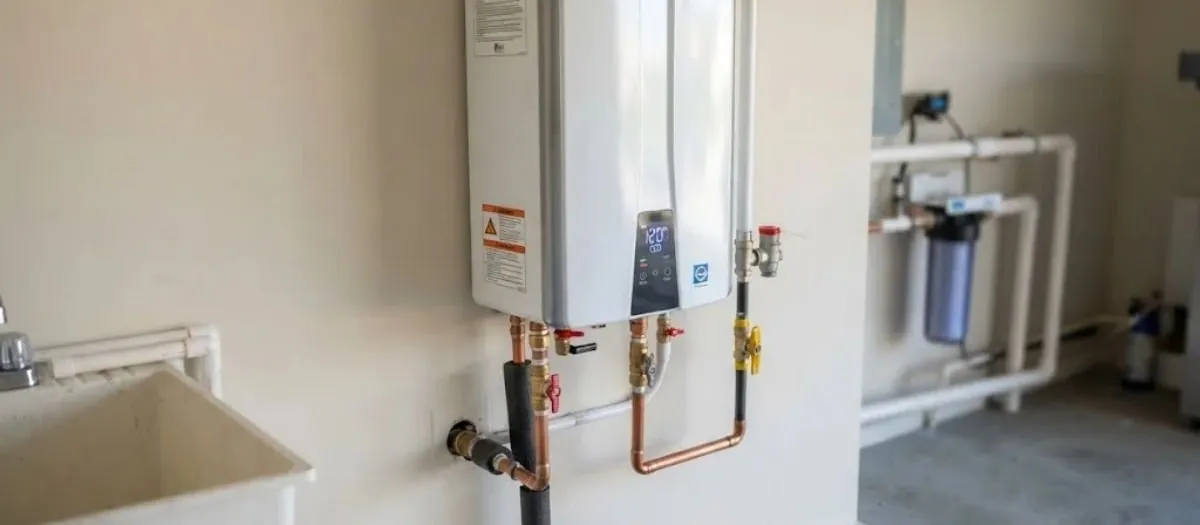
A tankless water heater heats water only when you open a tap. There is no tank of stored hot water to run out, and the unit is a fraction of the size. Those are real advantages. So are the limits. A tankless heater has a flow ceiling, it often needs a bigger gas line and new venting, and it asks for regular descaling.
This page lays out what the U.S. Department of Energy says, what a plumber checks before recommending one, and how the local permits and rebate fit in. Call (503) 974-3329 to schedule a visit and get a clear price before work starts. A plumber can tell you whether tankless suits your home.
What Tankless Does Well and What It Does Not
The Department of Energy says tankless heaters last roughly 20 years or more, compared with 10 to 15 for a storage tank. They are also more efficient because they do not keep a tank warm all day. They cost more up front. The savings show most in homes that use a modest amount of hot water.
Two common myths are worth clearing up. A tankless heater does not deliver hot water to the tap any faster, because the wait is still the water in the pipe between the heater and the faucet. And a gas model does not work in a power outage, since electronic ignition and a fan need power. If either of those matters to you, we will say so before you spend money.
Flow Limits: How Many Taps at Once
A tankless unit is rated by how many gallons per minute it can heat by a given temperature rise. DOE notes that output is limited to a few gallons per minute, and that the heater needs a minimum flow, about 0.5 gallons per minute, before it will fire. A dribbling faucet can leave you with lukewarm water.
Winter makes the math harder. Forest Grove's January average low is about 32.6 degrees Fahrenheit, and colder incoming water means the heater has to work harder to reach the same temperature. That lowers how much flow it can supply at once.
| Use at the same time | What happens | Plan for it |
|---|---|---|
| Shower and dishwasher | Usually fine on a properly sized unit. | Check the rated flow. |
| Two showers and a washing machine. | Can exceed the flow limit. | Size up or add a second unit. |
| A low-flow faucet on a trickle. | May drop below the minimum to fire. | Open it a bit further. |
| Tub fill during cold weather. | Slower fill, less temperature rise. | Allow more time. |
| Whole house on one gas unit. | Needs the right size and gas supply. | Have the load calculated. |
Wondering if your household fits a tankless? Call and a licensed plumber will go through it.
Call (503) 974-3329The Gas Line Question
A tankless gas heater burns much more fuel at once than a tank does, so the gas line has to carry the load. Many homes have a line sized for the old tank, and sometimes it is too small. The plumber measures the run, counts the other gas appliances on the same line and sizes the pipe, work that falls under plumbing installation.
Anyone working on LP gas appliances or piping in Oregon must be licensed, and that includes homeowners. If you smell gas at any time, leave the building and call NW Natural at 800-882-3377 or 911 from outside. We do not diagnose gas leaks over the phone. Gas work is not a place to improvise.
Venting Is Where the Cost Climbs
DOE warns that tankless heaters can need costly venting, and the route often decides the quote. High-efficiency units produce cool, acidic exhaust that goes out through sealed plastic pipe. Older tank flues often cannot be reused. The route to an outside wall, the length and the number of elbows all affect the quote.
Condensate, the water formed in combustion, also needs a drain and sometimes a neutralizer. Wall penetrations must be sealed, clearances from windows and meters observed, and a termination chosen that will not blow exhaust back into the home. A good plan starts with a look at where the unit will hang.
Permits for Both Sides of the Unit
Under Oregon's Building Codes Division, gas piping and the flue need a mechanical permit, while the water piping to a tankless needs a plumbing permit. The City of Forest Grove Community Development office handles building and plumbing permits at 503-992-3229. The person doing the work pulls the permit, and it expires if work does not begin within 180 days.
Water heaters must also be properly secured, and relief valve discharge handled correctly. If you are replacing a failed tank rather than planning ahead, our water heater replacement page explains the steps for a swap. For a bigger project that moves a heater, see our installation guide.
Scale, Soft Water and Descaling
DOE says tankless units scale up in hard water, and the heat exchanger needs flushing with descaling solution as the manual directs. Scale narrows the passages and cuts efficiency. Forest Grove's City reports do not list hardness, so we do not quote a number. The City water treatment team at 503-992-3259 can tell you what to expect.
Nearby towns differ. Hillsboro reports very soft water, about 1.52 to 1.86 grains per gallon, and North Plains reports soft water at about 1.80 to 2.16 grains per gallon. Soft does not mean no maintenance, though. Cost guides such as HomeGuide put a tankless flush at about $150 to $350.
A Rebate Worth Checking: Gas Tank to Gas Tankless
NW Natural and Energy Trust offer a $400 cash incentive for replacing a natural gas tank water heater with an ENERGY STAR gas tankless in an existing home. The unit has to connect to an existing half inch or three quarter inch gas line. The offer ends January 31, 2027. The phone number is 503-220-2360.
Terms change and funds run out, so check current terms before you buy. Notice the condition about the existing gas line. If your line needs upgrading, the project may not qualify, and you want to know that before the unit is ordered.
What a Tankless Installation Costs
Cost guides report gas tankless installs at about $1,650 to $3,500 (This Old House). Angi puts the Portland average at about $2,800 (range $1,692 to $3,988). Those are guide figures, not our price. We give you a clear price before work starts.
Unit size and brand
A unit sized for the whole house costs more than one sized for a small home.
Gas line upgrade
A larger or longer gas pipe adds materials and labor.
Venting route
Long runs, extra elbows and wall work add up fast.
Condensate and drain
A neutralizer and drain line are often needed.
Permits and water lines
Both the mechanical and plumbing permits apply, and the water connections may need to be reworked.
A planned upgrade is not an insured loss, since nothing has failed. If your old tank leaked and caused damage, the repair claim is separate from the cost of the new unit. Save your paperwork and the permit record, and check any incentive terms before you buy.
To price a tankless install, call (503) 974-3329 and tell us about your gas line.
Ready to plan a tankless upgrade? Call to schedule a visit with a licensed plumber.
Call (503) 974-3329