

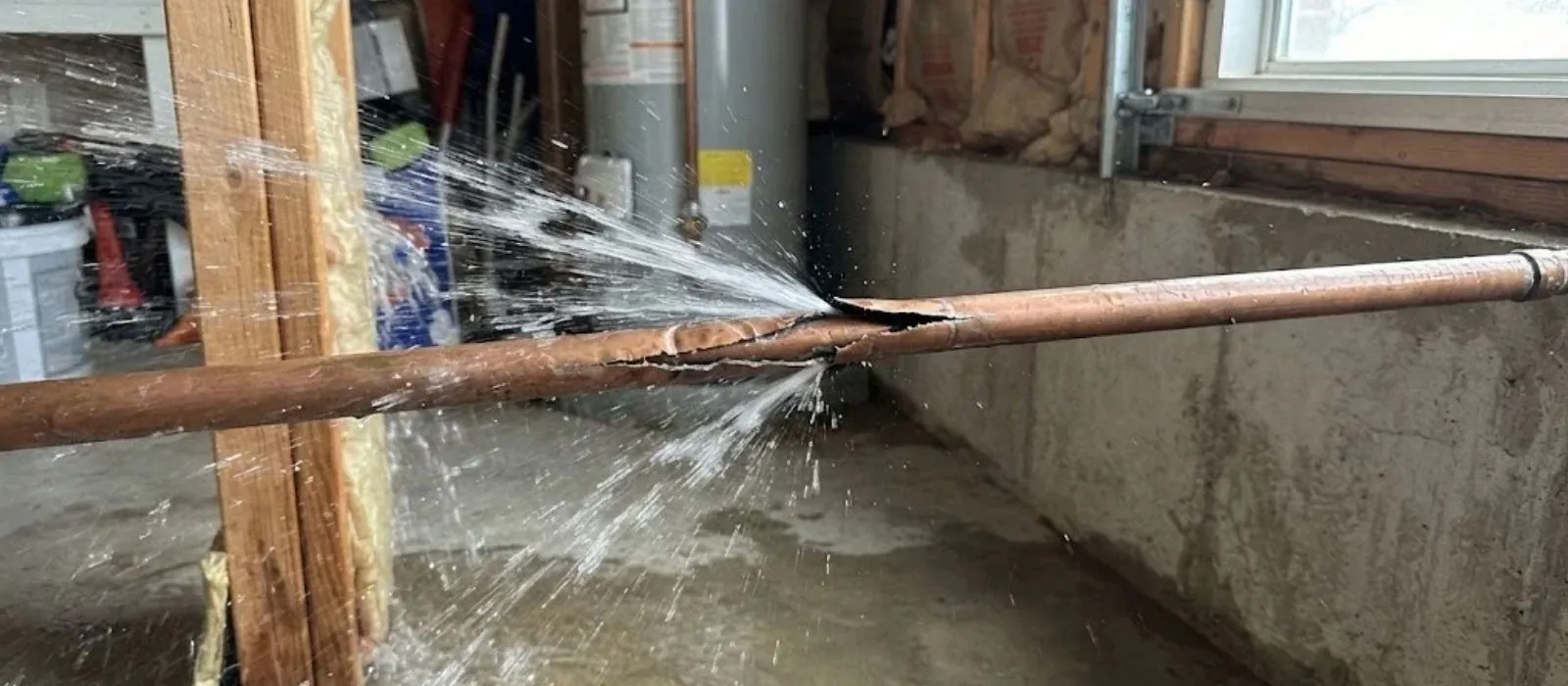
If you think pipes are frozen in your crawl space, open the faucet that has gone quiet, turn the heat up, and warm the cold pipe slowly with a hair dryer or heating pad. Never use a torch or open flame. If no water comes back, or you see a split or a wet spot, close the main valve at the house and call (503) 974-3329. That is the short answer for Forest Grove homes.
The longer answer matters because the damage rarely happens during the freeze. It happens when the ice melts and water pours out of a crack nobody saw. Here is how to thaw safely, how to spot trouble, and what to do before the next cold night.
Clues that ice is sitting under your floor
Frozen crawl space pipes announce themselves at the fixture. One tap runs a trickle or nothing, the toilet refills slowly, or the whole house loses water on a cold morning. If only the hot side is dead, the freeze is on the hot line.
In the crawl space itself, look for white frost on a pipe, a section that feels colder than the pipes beside it, or a pipe that looks slightly swollen. A hissing or ticking sound can mean ice is pushing against a joint. Wet insulation or a damp patch on the dirt after a thaw is a red flag for a split.
| What you notice | Likely meaning | First move |
|---|---|---|
| No water at one faucet. | Short frozen section on that branch. | Open the tap, warm the pipe. |
| Frost or bulge on a pipe. | Ice is present, pipe is under stress. | Start slow warming right away. |
| Wet insulation or dripping under the floor. | Pipe may already be split. | Close the main valve at the house and call. |
| Stain on a ceiling or wall after a thaw. | Concealed pipe may have burst. | Close the main valve and call. |
Thawing a crawl space pipe without making it worse
The Red Cross advice is simple and worth following exactly. Heat the pipe slowly, from the faucet end back toward the ice, so melting water has somewhere to go. Open the tap so water and steam can escape as the ice breaks up.
- Open the faucet fed by the frozen line, hot and cold if you are unsure.
- Turn the thermostat up and open cabinet doors on exterior walls so warm air reaches the pipes.
- Enter the crawl space with a good light, gloves and a dry footing. Do not work in standing water near outlets or extension cords.
- Warm the pipe with a heating pad or hair dryer, starting near the faucet side of the frozen section and working toward the cold end.
- Keep going until full flow returns, then leave the tap dripping while you check the entire run for leaks.
- If a pipe has frozen once, check the others. The Red Cross notes that when one pipe freezes, others may too.
Never use an open flame, a blowtorch or a propane heater. If you cannot reach the pipe, or the crawl space is tight and wet, stop and call (503) 974-3329. Cost guides such as Angi and HomeAdvisor put a flat thawing fee at about $100, which is a small price compared with a flooded crawl space.
How cold it actually gets in Forest Grove
NOAA's 1991 to 2020 normals for the Forest Grove station show an average January low of 32.6 F, December at 32.8 F and February at 33.1 F. That is right at the edge of freezing, not far below it. Winters here are wet more than they are frigid, with about 46.72 inches of precipitation a year.
Averages hide the cold snaps. A few nights well under freezing are enough to turn a ventilated crawl space into a refrigerator, especially when wind blows through open foundation vents. The pipes that suffer sit in crawl spaces, attics, garages and outside walls.
Water won't come back after thawing, or you see a wet spot? Call and talk it through with a plumber.
Call (503) 974-3329Cold-night prevention that costs little
Prevention is cheap and takes an afternoon. Wrap exposed lines in foam sleeves, seal gaps where pipes enter the floor, and keep the house at 55 F or higher even when you travel. Let a cold-water faucet on an exposed run drip during a hard freeze.
Insulate the exposed runs
Foam sleeves fit most supply lines. Close the seams with tape and cover elbows and valves.
Stop the cold draft
Look at foundation vents and gaps around pipes that pass through the rim. Covers or sealed gaps keep wind off the lines.
Drip the right faucet
Choose the tap on the exposed run or the one farthest from where water enters the house.
Shut off outdoor taps
Close the inside valve feeding each hose bib, then open the outside bib to drain it and remove the hoses.
Electric heat tape can help, but follow the maker's instructions exactly. A pipe that keeps freezing in the same spot may need to be rerouted inside the insulated part of the house. A plumber can look at rerouting it, and repiping is the bigger fix if the run is old.
Burst risk and what a split pipe costs
Water expands as it freezes, which is why a pipe can crack. The split often forms between the ice plug and the closed faucet, where pressure builds, and you will not see it until the ice melts.
Repair costs vary with access. Cost guides report a burst pipe repair average of about $500 from Angi, and $400 to $2,000 from HomeGuide, with an emergency call-out adding roughly $100 to $300 according to HomeAdvisor. A crawl space with poor access sits toward the higher end, and your plumber will give a clear price before work starts.
There is a permit angle too. Oregon requires a permit for emergency repair of freeze-damaged or leaking concealed piping if the new piping exceeds five feet. A licensed plumber handles that paperwork as part of burst pipe repair.
Freeze advice from neighboring towns
Local utilities give practical guidance that applies to your crawl space as well. The city of North Plains tells residents to keep the thermostat at 55 F or higher, thaw with a hair dryer, heat lamp or space heater and never open flame, and disconnect hoses before the first freeze. Homes there grew from 749 to 1,266 between 2010 and 2020, so many are newer, but exposed crawl space pipe in any house still needs protection.
Cornelius adds a useful rule. The City says to keep a steady drip at the faucet farthest from the meter, and notes that it is responsible for a frozen main or meter, not pipes inside the home. If the ice is inside your walls or crawl space, the repair is yours.
In Banks and the rural addresses around it, check the water source. Private well owners should also check the pressure tank and any pipes in an outbuilding or well house, because those freeze too.
Forest Grove Note: the meter rule and older homes
Forest Grove's City policy is that customers and contractors never turn water off at the city meter. Use the main shutoff valve at the house. If it fails or you cannot reach it, call Public Works at 503-992-3258 and the City will shut it off, with no fee in business hours and a fee after hours. If someone closes it at the meter and the meter or line breaks, the repair is at the homeowner's expense.
Housing age matters for crawl spaces. The median Forest Grove home was built in 1982, but about 48% of homes predate 1980, including 1,030 built in 1939 or earlier. Older crawl spaces are more likely to have exposed runs and thin insulation.