

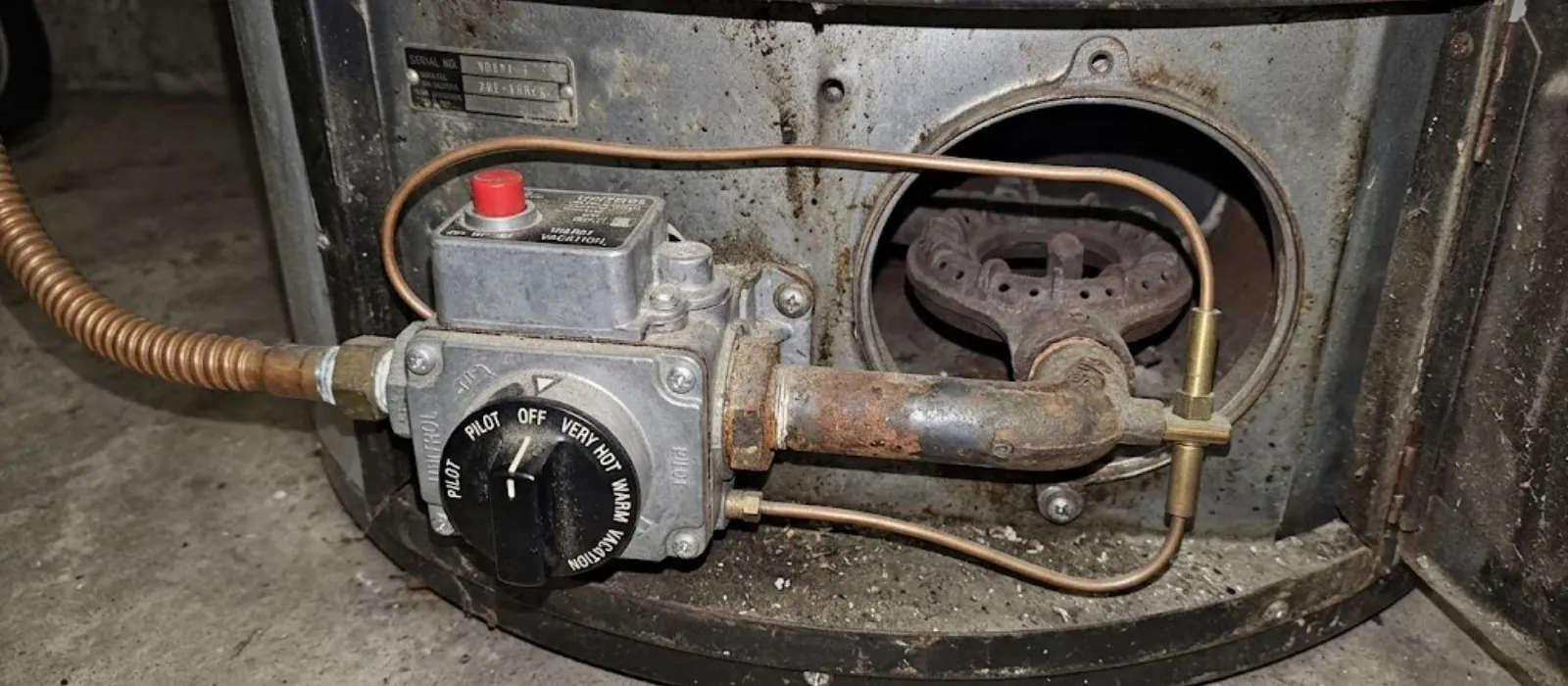
If your hot water heater is leaking from the bottom, the answer is usually to replace it. Water that seeps out of the tank shell means the steel has rusted through, and no patch holds. Water from a fitting, a valve or the relief pipe can often be repaired. Shut off the power or gas and the cold water supply first, then work out which case you have.
The tricky part is that water runs downhill. A drip from a connection near the top of the heater can run down the jacket and pool at the base, which makes a cheap repair look like a dead tank. The steps below sort that out.
Sorting a fitting leak from a tank leak
Start by making the area safe. If you smell gas, leave and call NW Natural at 800-882-3377 or 911 from outside. If not, turn the gas control to off, or flip the breaker at the panel for an electric unit, but never wade through standing water to reach it. Then close the cold water valve on the feeding pipe, dry the heater and watch where fresh drops appear first.
- Wipe the top of the heater and both pipe connections dry, then check them with a flashlight and a dry paper towel.
- Look at the temperature and pressure relief valve on the side or top and at the discharge pipe running down from it. Drips here point to a valve or a pressure problem.
- Check the drain valve near the bottom. A slow weep at the spigot is common and often fixed by tightening a cap or swapping the valve.
- Slide a dry paper towel under the tank base. If it is soaked after an hour and everything above stayed dry, the leak is inside the tank.
- Look for a rust trail or flaking along the bottom seam. Rust staining at the base is a late warning sign.
| Where it shows up | Likely cause | Repair or replace |
|---|---|---|
| Pipe connections at the top. | Loose or worn fitting, failed dielectric union. | Repair. |
| Relief valve or its discharge pipe. | Worn valve or high pressure in the house. | Repair, plus check pressure. |
| Drain valve at the bottom. | Worn valve seat or loose cap. | Repair. |
| Heating element gasket (electric). | Failed gasket or loose element. | Repair. |
| Seam or base of the tank. | Corroded tank shell | Replace. |
| Dripping inside a gas burner area. | Often condensation, sometimes the tank. | Have a plumber confirm. |
Why a leaking tank shell cannot be patched
A storage tank is a steel cylinder with a glass-like lining on the inside. Over the years the lining cracks and the steel corrodes from the inside out. An anode rod is meant to corrode first, but once it is used up the tank wall is next.
Epoxy, sealant and clamps do not last on a pressurized vessel that heats and cools every day. A plumber will not repair a shell leak because the next weak spot is usually close by.
Condensation can fool you. A gas heater firing up with cold incoming water can sweat and drip for a few minutes. If the drips stop once the tank is warm, that is not a leak.
Using the 10 to 15 year age rule
The US Department of Energy says storage water heaters last roughly 10 to 15 years. The data plate on the side gives a serial number that usually encodes the build month and year, and the manufacturer's site or a plumber can decode it. Age is the tiebreaker when the leak source is unclear.
A heater under about eight years old with a leaking fitting is a good repair candidate. A heater past 12 with any sign of tank rust is not worth chasing. In between, ask what else is wearing out. If the anode is gone and the valve is weeping, one repair tends to be followed by another.
Not sure which kind of leak you have? Call and describe where the water is showing up.
Call (503) 974-3329What repair and replacement typically cost
Cost guides give a useful picture, though your actual price depends on access, fuel type and what the old unit connects to. We give a clear price before work starts. These are typical published figures, not quotes.
| Job | Typical range | Source |
|---|---|---|
| Water heater repair, Portland area. | Average $690 ($266 to $1,114). | Angi. |
| Standard tank installed | $600 to $3,100 | HomeGuide. |
| Standard tank installed | $882 to $1,826 | Angi. |
| Gas tankless installed | About $1,650 to $3,500. | This Old House. |
| Heat pump water heater installed. | $2,000 to $4,600 | HomeGuide. |
| Expansion tank add-on | Average $325 ($150 to $450). | Angi. |
The wide spread comes from venting, gas line work, tank size and access. A tankless unit costs more up front and may need a larger gas line. If the tank is near the end of its 10 to 15 years, putting several hundred dollars into a worn unit rarely pays back. A bottom leak is a natural moment to compare a new tank with a tankless model.
Permit, strap and code items on a replacement
In Oregon, replacing a water heater takes a plumbing permit, and the person doing the work pulls it. In Forest Grove that goes through Community Development at 1924 Council St, phone 503-992-3229. Your plumber normally handles the paperwork. If you are weighing a do-it-yourself swap, the permit still applies to you.
Oregon's plumbing code, based on the Uniform Plumbing Code, also expects the heater to be anchored or strapped against earthquake movement. When a heater is replaced, thermal expansion protection and the termination of the relief valve discharge are code items too. That is why an water heater replacement often includes an expansion tank and a new discharge line.
Rules differ one town over. Cornelius contracts its building services from the Forest Grove Building Division, so a Cornelius replacement runs through the same office. Hillsboro issues its own plumbing permits, and a permit is required there to replace a water heater too. A Hillsboro homeowner calls that city's Development Services.
What to do while the leak runs
If water keeps running and you cannot slow it, close the main shutoff valve at the house. Do not turn it off at the city water meter. If you smell gas near a gas heater, leave the building and call NW Natural at 800-882-3377 or 911 from outside.
Most bottom leaks are slower than that. Close the cold water inlet valve on top of the heater, switch off the power or gas, and put a shallow pan under the tank. A full tank keeps trickling until the water level drops below the hole.
Then call (503) 974-3329 and describe the make, size and where the unit sits. A leak that reached drywall or flooring is also worth mentioning so the visit can include a leak check on nearby lines.
Forest Grove Note: city water, the meter rule and older homes
Forest Grove runs its own city water utility, and the City's policy is that customers and contractors never turn water off at the meter. If the main shutoff inside your house will not close, call Public Works at 503-992-3258 and the City shuts it off. There is no fee during business hours, and a fee applies after hours.
About 48% of Forest Grove homes were built before 1980, so many have older plumbing around the heater. Updating shutoff valves and supply connectors during a swap is cheap while the area is already open.