

A sewer smell in a Forest Grove house most often comes from a dry P-trap, a worn wax ring under a toilet, or a floor drain that has not seen water in months. Run water into every drain you rarely use, check the base of each toilet, and see if the smell fades. If it keeps returning, the problem is likely in the vent or the sewer line itself.
One warning first. If the smell is more like rotten eggs than sewage, treat it as a gas smell. Leave the building and call NW Natural at 800-882-3377 or 911 from outside. We do not diagnose gas leaks over the phone.
Check the drains nobody uses
Every sink, tub and floor drain has a curved pipe called a P-trap. It holds a few inches of water that blocks sewer gas from rising into the room. When a fixture sits unused, that water evaporates, and the smell walks right in. Guest bathrooms, basement floor drains, utility sinks and laundry standpipes are the usual suspects.
Run the tap for a minute or pour a quart of water down the drain, then wait a few hours. If the smell fades, you found it. Do it monthly for fixtures you rarely use. A trap that keeps going dry even with regular use may be leaking or siphoning, and that is a plumber's call.
A floor drain deserves extra attention because it has no daily traffic. Basement and garage floor drains see little water, so their trap seals can dry out within weeks. A trap primer or a quick pour every few weeks keeps the seal in place.
A room-by-room smell map
Where you smell it narrows things quickly. Walk through the house with a fresh nose and note which room is strongest. The pattern below covers the common cases.
| Where you smell it | Likely cause | What to try first |
|---|---|---|
| Guest bath or rarely used sink. | Dry P-trap | Run water for a minute, wait a few hours. |
| Around a toilet base. | Failed wax ring or loose flange. | Check for rocking or damp floor. |
| Basement or garage floor drain. | Evaporated trap seal | Pour in water, repeat monthly. |
| Whole house, worse outdoors near a wall. | Blocked vent or damaged line. | Call for a camera look. |
| Smell with gurgling drains. | Venting problem or partial blockage. | Test fixtures one at a time. |
| Smell with slow drains everywhere. | Main line trouble | Stop using water and call. |
Toilet seals and the plumbing vent
A toilet sits on a wax ring that seals it to the drain flange. When the ring flattens or the toilet rocks, gas escapes at the floor and moisture soaks into the subfloor. Rock the bowl gently. Any movement, a dark stain on the floor tile, or a smell that is strongest at the base points to the ring. Cost guides put a wax ring job at about $55 to $230.
Plumbing vents let air into the system so water drains smoothly and gas travels up and out through the roof. A blocked vent makes drains gurgle and can push smells into the house. Do not climb on the roof to look. One guide puts vent clearing at about $150 to $200. Treat that as a rough sense of scale.
If a P-trap itself is cracked or corroded, replacement runs about $200 to $325. Your plumber can tell you if the smell is a trap, a vent or a seal. A toilet repair visit can often fix the ring and check the flange in one trip.
Tried the simple fixes and the smell keeps coming back? Call and describe where it is strongest.
Call (503) 974-3329When the smell points to the line outside
If the smell comes and goes with weather, shows up in several rooms at once or appears with backups, the line under the yard becomes the suspect. Cracks, offset joints and roots can let gas escape and let groundwater or roots in. A sagging stretch holds water and waste and smells as it sits.
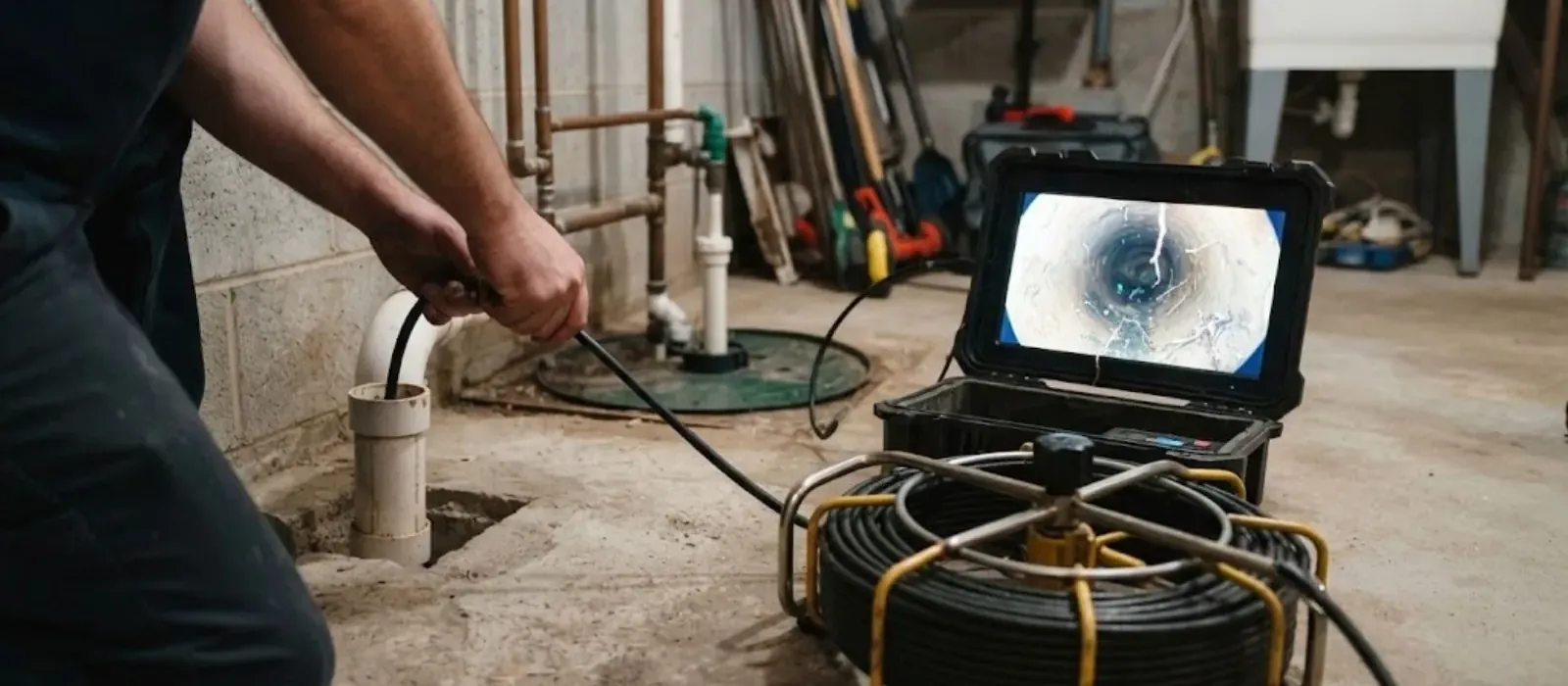
The clearest test is a camera inspection. According to the EPA, camera inspection is the most commonly used technique for looking inside a sewer. Cost guides vary widely, so expect roughly $125 to $1,000 depending on access and the report.
A cleanout, the capped pipe near the foundation or in the yard, is usually where the camera goes in. A sewer camera inspection shows the pipe's condition and where any defect sits.
| Job | Typical range | Source |
|---|---|---|
| Wax ring replacement | $55 to $230 | Cost guides. |
| P-trap replacement | $200 to $325 | Cost guides. |
| Drain cleaning, national | $147 to $352 | Angi. |
| Sewer camera inspection | Roughly $125 to $1,000. | HomeGuide, HomeAdvisor. |
| Sewer spot repair | Average about $2,600 ($1,100 to $4,100). | Angi 2026. |
If the camera shows a blockage, drain cleaning may solve it. If it shows a crack or a collapsed section, a sewer line repair follows. Work on a lateral may need a plumbing permit, an erosion control permit and utility locates through 811. You will get a clear price before work starts.
A gas smell is not a sewer smell
If you smell gas, do not hunt for the source. Leave the building, then call NW Natural at 800-882-3377 or 911 from outside. Do not use light switches, lighters or your phone inside the home.
Sewer gas and natural gas can both smell like sulfur, so people mix them up. If you are not sure which one you smell, treat it as natural gas and leave.
Once NW Natural has cleared the home, you can chase the smell with the steps above. If the smell turns out to be plumbing, call (503) 974-3329 and describe which room is strongest.
If sewage is coming back up
Sewage in a tub, shower or floor drain is a backup, not a smell. Stop using water, do not flush, and keep people and pets out of the area. Call (503) 974-3329 right away. A backup means the line is blocked somewhere downstream, either on your side or in the public main.
Ownership works the same way nearby. In Hillsboro, property owners are responsible for their own laterals, and the city has run a Lateral Accuracy Project since 2021 to mark them. In Cornelius, the city maintains the main and the owner handles their own side. A camera shows which side holds the blockage.
Please keep wipes, paper towels and grease out of the drain. Clean Water Services asks residents not to flush wipes, even ones labeled flushable, and they inflate backups and bad smells alike.
Forest Grove Note: who owns which part of the sewer
In Forest Grove, the City maintains collection lines smaller than 24 inches and all manholes. Clean Water Services handles trunk lines, lift stations and the Fernhill Treatment Facility. The private sewer lateral, from your house all the way to the public connection, belongs to the property owner under City Ordinance 52.03. The City's after-hours sewer emergency line is 503-412-2444.
Clean Water Services Field Operations at 503-547-8100 may repair a structural defect, such as a cracked pipe, open joint or root intrusion, when it sits within the public right of way. A plumber can send them a camera video to request help. A sag, or belly, does not count as structural. Forest Grove also has older housing, including 1,030 homes built in 1939 or earlier.