

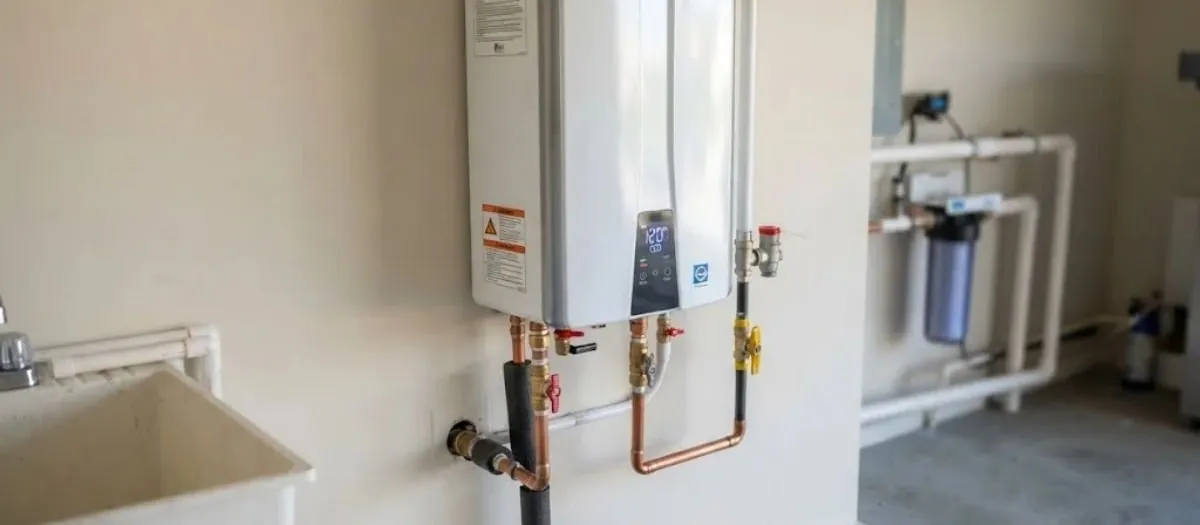
If your tankless water heater is leaking in Forest Grove, shut off the water to the unit, turn off its power, and close its gas valve if you can reach it safely. If you smell gas, do not touch anything. Leave the building, then call from outside to the gas company at 800-882-3377 or to 911.
Once the unit is isolated, look at where the water is coming from. A drip at a pipe connection is a very different problem from a leak out of the casing. This guide walks through the usual sources, what you can check yourself, and the point where it is time to call (503) 974-3329.
Isolating the Unit Before You Look Closer
A tankless heater has four things you can shut off. If you smell gas, do not shut anything off. Leave the building and call from outside. With no gas smell, start with water, then power, then the gas valve.
- Close the cold water isolation valve on the supply side of the unit.
- Close the hot water isolation valve on the outlet side, if the unit has one.
- Switch off the power at the breaker from a dry spot. Never stand in water to unplug the unit or reach the panel.
- Close the gas shutoff valve on a gas model if you can reach it and smell nothing.
- Dry the area so you can see where new water appears.
If you cannot shut off the isolation valves, close the main shutoff valve where the water line enters the house. Never close the water at the city meter. In Forest Grove, the City's policy is that customers and contractors leave the meter alone, and if the meter or line breaks after someone shuts it there, the repair is at the homeowner's expense.
If You Smell Gas, Stop Here
If you smell gas, leave the building now. Do not use a light switch, a phone inside or the heater. From outside, call the gas company at 800-882-3377 or 911. Water leaks can wait until the gas company has cleared the home.
Where Tankless Leaks Come From
Tankless units are compact, and a lot happens inside a small case. Water can escape at the connections underneath, from a valve, from the heat exchanger or from the condensate drain. Work out which area is wet before you decide what is wrong.
| Where the water shows up | Likely source | Who handles it |
|---|---|---|
| Under the unit at a pipe fitting. | Loose or worn connection, failed washer or union. | Often a plumber, sometimes a simple tightening. |
| From the isolation valves. | Worn valve packing or seal. | Plumber. |
| From a relief valve or its pipe. | Excess pressure or temperature, or a worn valve. | Plumber, since the valve protects the unit. |
| From the condensate line or trap. | Blocked drain or cracked trap on a condensing unit. | Plumber or service tech. |
| From inside the casing. | Failed heat exchanger or internal seal. | Plumber, and often a replacement conversation. |
Water runs downhill. A drip at a fitting near the top can run down the unit and pool at the bottom, which makes a cheap fix look like a dead heater. Wipe it dry and watch where the first bead forms.
Connection Leaks and Isolation Valves
Connections are the most common source. Thermal cycling loosens fittings, and washers in unions wear out. If the drip is at a connection, tightening a little may stop it.
Do not force a fitting hard. Overtightening cracks washers and strips threads, and it can turn a drip into a spray. If a quarter turn does not fix it, let a plumber replace the washer or fitting.
Isolation valves leak at the stem when the packing wears. A weeping stem is a small leak, but it can corrode the unit's bottom connections over time, so do not leave it. A plumber can replace the valve, and a pair of service valves also makes later descaling easier.
If the leak does not stop with the water off, call and a plumber can come look at the unit.
Call (503) 974-3329Scale Inside the Heat Exchanger
US Department of Energy guidance says tankless heaters scale up in hard water, and the heat exchanger needs flushing with a descaling solution as the manual directs. Scale narrows the tiny passages inside. Flow drops, the unit runs hotter, and parts and seals can wear sooner.
Water in Forest Grove comes from the City's Clear Creek Watershed and treated water from the Joint Water Commission, but the City's reports do not give a hardness figure. Call the City water treatment team at 503-992-3259 if you want to know. A plumber can also judge scale by what comes out when the unit is flushed.
HomeGuide puts a tankless flush at $150 to $350. That is a small number next to a heat exchanger. Skipping it can shorten the life of a unit that DOE says should last roughly 20 years or more.
Condensate, Pressure and the Relief Valve
High-efficiency condensing units pull so much heat from the exhaust that water vapor turns to liquid. That condensate drains out through a small line, often to a trap or neutralizer. If that line clogs, kinks or freezes, water backs up and spills near the unit.
A leaking relief valve points to excess pressure or temperature. It can also be a worn valve. The valve is a safety part, so do not cap it or plug its drain. If thermal expansion is the cause, the fix may be an expansion tank on the supply line.
A leak from inside the casing is the one that worries plumbers. That points to a cracked heat exchanger or a failed internal seal. Do not run the unit. The repair may cost close to a new one, and sometimes replacement is the sensible path.
Cost Ranges and Repair or Replace
Cost guides help you set expectations. Angi's Portland average for water heater repair is $690 ($266 to $1,114). A new gas tankless installed runs about $1,650 to $3,500 according to This Old House, and Angi's Portland tankless average is $2,800 ($1,692 to $3,988).
| Item | Reported figure |
|---|---|
| Water heater repair, Portland. | Average $690 ($266 to $1,114) per Angi. |
| Tankless flush | $150 to $350 per HomeGuide. |
| Gas tankless installed | About $1,650 to $3,500 per This Old House. |
| Tankless installed, Portland | Average $2,800 ($1,692 to $3,988) per Angi. |
A cracked heat exchanger on an old unit is a different story from a loose fitting. The decision is partly about age and partly about whether parts are still available. The price is settled before work starts. To talk through your unit, call (503) 974-3329.
Permits, Gas Work and Who Should Touch It
Oregon requires a license for anyone, including a homeowner, who installs or repairs LP gas appliances or piping. Gas piping and the flue need a mechanical permit, and water piping to a tankless heater needs a plumbing permit, according to a Building Codes Division interpretation.
So tightening a fitting is one thing and rework of the gas connection or venting is another. Our tankless water heater service handles both repair and replacement, and leak detection helps if you cannot tell where the water is entering the room.
Forest Grove Note: Gas, Water and Neighbors
Gas in this area is supplied by NW Natural, and a gas emergency number is 800-882-3377. Forest Grove Light & Power is city-owned, and its line is 503-992-3250, with after-hours calls at 503-412-2444, which helps if the heater's power supply is the problem. If you are replacing instead of repairing, NW Natural lists a $400 incentive for swapping a gas tank heater for a gas tankless through January 31, 2027, so check current terms at 503-220-2360.
Homes in Cornelius and Banks may have different water sources. Cornelius buys from Hillsboro, while Banks draws on springs and wells.