

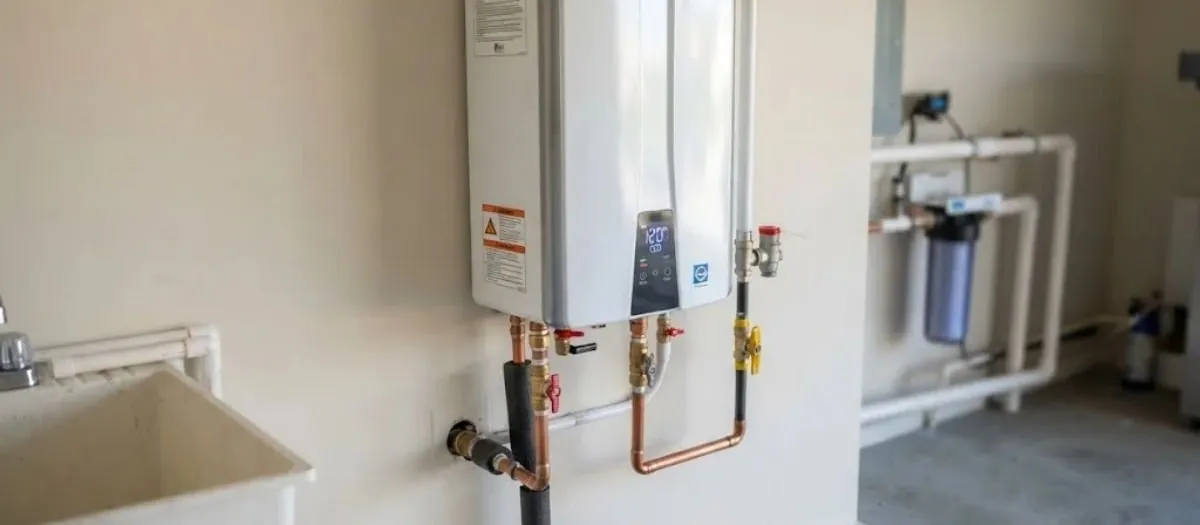
A tankless water heater is worth it for many Forest Grove households, but not all of them. The pros are a longer life, better efficiency and no tank to rust through. The cons are a higher install price, limited flow, possible gas line and venting upgrades, and the need to descale the heat exchanger.
Whether the trade is a good one depends on your house. This guide covers what the US Department of Energy says, what a plumber checks, what cost guides report, and the rebate now open.
Where Tankless Wins
A storage heater keeps a full tank hot around the clock, whether you use it or not. A tankless unit heats water only when a tap opens, so it avoids that standby loss. The US Department of Energy notes that tankless heaters are more efficient than storage models.
They also last longer. The DOE puts storage heaters at roughly 10 to 15 years and tankless at 20 years or more. A tank that is replaced once in that span has to be bought, hauled and installed twice.
Space is the other easy win. A wall-mounted unit frees up floor area, and with no tank there is nothing to rust through.
Where It Falls Short
The DOE is just as plain about the downsides. Tankless heaters cost more up front, deliver only a few gallons per minute, and need a minimum flow of about 0.5 gallons per minute before they will fire. A faucet turned to a thread of water may stay cold.
They do not deliver hot water to the tap any faster, either. The pipe between the heater and the faucet still holds cold water that has to be pushed out first. And they do not work in a power outage, even gas models, because the fan and electronic ignition need electricity.
| Factor | Tankless | Storage tank |
|---|---|---|
| Typical life (DOE) | 20 years or more. | 10 to 15 years. |
| Energy use | Lower, no standby loss. | Higher, keeps water hot all day. |
| Hot water supply | Endless but flow-limited | Limited by tank size, then recovers. |
| Upfront cost | Higher | Lower. |
| Power outage | No hot water | Stored hot water remains. |
| Maintenance | Periodic descaling flush | Periodic flush and anode check. |
Weighing a tankless install for your house? A licensed plumber can look at the gas line and vent path first.
Call (503) 974-3329The Gas Line Question Most Brochures Skip
A tankless gas unit burns a lot of fuel in a short burst. It asks for far more gas volume at once than a tank burner does. A line that was sized for a tank heater and a stove can be too small to feed both a tankless unit and the rest of the house.
Your plumber measures the line run, counts the other gas appliances and compares the total against the unit's input rating. If the line is too small, it has to be upsized, which adds labor and parts. The NW Natural rebate mentioned below requires an existing 1/2 or 3/4 inch gas line, so that detail matters for the incentive too.
If you ever smell gas, leave the building first. Call NW Natural at 800-882-3377 or 911 from outside. Do not try to find the leak yourself.
Gas piping and the flue also need a mechanical permit in Oregon. Anyone who installs or repairs LP gas appliances or piping, homeowners included, must be licensed.
Venting and Permits Decide the Real Price
The DOE warns that tankless units can need costly venting. High-efficiency models make cool, wet exhaust that is vented through plastic pipe, often out a side wall. Older tank heaters usually vent up a metal flue. Swapping one for the other means new wall penetrations and new clearances.
Water piping to a tankless unit needs a plumbing permit, according to an Oregon Building Codes Division interpretation. In Forest Grove, the Community Development office at 1924 Council St issues plumbing permits, and its number is 503-992-3229. Whoever does the work gets the permit, so ask your plumber to confirm who is pulling it.
Water heater replacement in general needs a permit, and the Oregon Plumbing Specialty Code covers anchoring, thermal expansion protection and relief-valve termination when a heater is replaced.
What Cost Guides Report
Prices swing with venting, gas line and how far the unit sits from existing pipes. Cost guides give a useful range. This Old House reports gas tankless installs at about $1,650 to $3,500. Angi lists the Portland tankless average at $2,800 with a range of $1,692 to $3,988.
| Water heater type | Reported range | Source |
|---|---|---|
| Gas tankless | $1,650 to $3,500 | This Old House. |
| Tankless, Portland average | $2,800 ($1,692 to $3,988). | Angi. |
| Standard tank | $600 to $3,100 | HomeGuide. |
| Standard tank | $882 to $1,826 | Angi. |
| Heat pump | $2,000 to $4,600 | HomeGuide. |
A tank is cheaper at install, but the lifespan numbers narrow the gap. Over 20 years, one tankless unit may cost about what two tanks do. We give a clear price before work starts so you can compare real numbers for your house.
Rebates Worth Checking Before You Buy
NW Natural and Energy Trust of Oregon offer a $400 cash incentive for replacing a natural gas tank water heater with a gas tankless model. It must be ENERGY STAR rated, go into an existing home, and use an existing 1/2 or 3/4 inch gas line. The offer expires January 31, 2027, and the number to call is 503-220-2360. Check current terms before you commit.
Energy Trust also lists $1,200 for heat pump water heaters through retailers and distributors, at energytrust.org/water.
Confirm eligibility before you buy. A tankless water heater installation by a licensed plumber fits the permit and gas rules above. Ask the program line what it requires.
Hard Water, Soft Water and Scale
Minerals in water settle out when it is heated. On a tankless unit that scale builds inside the heat exchanger and narrows the passages, which raises the temperature, lowers the flow and shortens the life. The DOE says tankless heaters scale up in hard water and the heat exchanger needs flushing with descaling solution as the manual directs.
How often depends on how hard your water is. Nearby Hillsboro reported very soft water in its 2024 report, between 1.52 and 1.86 grains per gallon. North Plains, which buys water through Hillsboro and the Joint Water Commission, reported 1.80 to 2.16 grains per gallon, also soft. Soft water means slower scaling, though it does not mean never.
HomeGuide lists a tankless flush at roughly $150 to $350 against $75 to $150 for a tank. Follow your manual for timing.
Is Your House a Good Fit?
Tankless suits a home where the heater is on an outside wall, the gas line is already healthy, and demand is steady. A household running two showers and a dishwasher at once should size the unit for peak flow. A pair of units is sometimes the answer.
It suits less well when the heater sits deep in the interior with no easy vent path, the gas line would need a long upsizing run, or hot-water use is so light that the efficiency savings never pay back. If you decide to stay with storage, replacing a tank heater is the simpler job.
The same checklist applies in Hillsboro and North Plains. If you want a plumber to look at your setup, call (503) 974-3329.
Forest Grove Note: Water, Homes and Who to Ask
Forest Grove's water comes from the City's Clear Creek Watershed plus treated Joint Water Commission supply, so it is City-owned water. The City reports no lead or galvanized service lines needing replacement. The City reports do not publish hardness or pH, so we cannot give you a number. For hardness, call the City water treatment team at 503-992-3259 before choosing a descaling schedule.
The housing stock matters too. The median Forest Grove home was built in 1982 and about 48 percent of homes predate 1980. With that mix of ages, a visit to confirm gas capacity and vent routing is worth doing before you set a budget.