

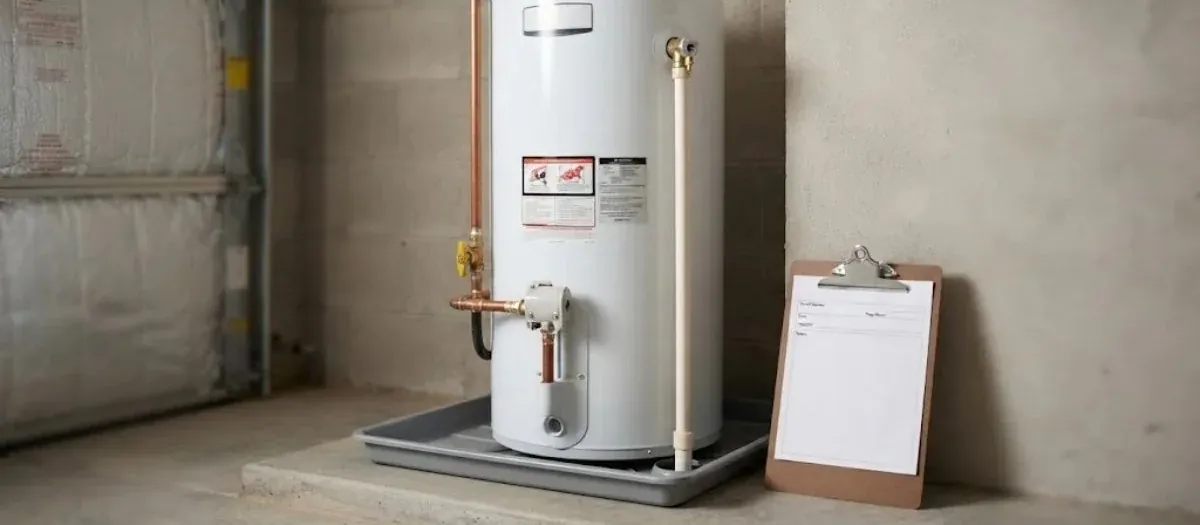
To flush sediment from a water heater in Forest Grove, shut off the power or gas and close the cold water inlet. Then connect a hose to the drain valve, open a hot tap upstairs, and drain the tank until the water runs clear. Close the valve, refill the tank, and only then restore power or gas. The whole job takes about an hour.
How often depends on who you ask. According to the US Department of Energy, you should flush a quart of water every three months, and EPA WaterSense says to flush the whole heater once a year. Either habit beats never doing it.
What settles at the bottom of a tank
Heating water drives dissolved minerals out of solution, and they sink to the floor of the tank as a gritty layer. That layer sits between the burner or element and the water, so the heater works harder to do the same job. You may hear popping or rumbling as steam bubbles push through it. Hot water may run out sooner.
In a gas heater the burner sits under that layer, which can overheat the steel. In an electric heater the lower element can get buried and burn out. Neither failure shows up on a schedule. Sediment is a quiet cost that builds until something gives.
Amounts vary with water chemistry. Hillsboro's 2024 report lists hardness of 26.1 to 31.9 ppm, or 1.52 to 1.86 grains per gallon, which is very soft water. Hillsboro heaters have less mineral to drop than heaters in a hard-water town. Rust and scale flakes from old pipes can still collect.
A maintenance calendar you can keep
DOE and Oak Ridge National Laboratory publish simple tank maintenance intervals. Most of them take five minutes. Put them on a calendar you will see, like the same weekend you change smoke detector batteries.
| Task | How often | Notes |
|---|---|---|
| Draw off a quart of water from the drain valve. | Every three months | Look for cloudy water, grit or rust flakes. |
| Full tank flush | Once a year | EPA WaterSense recommendation. |
| Test the temperature and pressure relief valve. | At least once a year, DOE says every six months. | Lift the lever briefly. |
| Inspect the anode rod. | Every three to four years. | Replace when mostly eaten away. |
| Descale a tankless heat exchanger. | Per the manual | Scale builds in hard water. |
Flushing a storage tank in order
You need a garden hose, a bucket for a first test draw, a screwdriver and a spot where hot water can drain safely, like a floor drain or the yard. Pick a time when nobody needs hot water for a few hours.
- Turn the thermostat to its lowest setting or the gas control to pilot. On an electric heater, switch off the breaker so the elements never run dry.
- Close the cold water valve at the top of the heater.
- Open a hot tap in the kitchen or a tub, which lets air into the system.
- Attach the hose to the drain valve at the bottom and run the other end to a drain or outdoors.
- Open the drain valve. The first water is hot, so keep skin and pets clear.
- Let the tank empty. Cloudy or gritty water at the start is normal.
- Open the cold inlet briefly a few times to stir the bottom, then drain again until the water runs clear.
- Close the drain valve, remove the hose, and open the cold inlet.
- Leave the hot tap open until water flows steadily with no sputtering, then close it. Restore the breaker or gas control only after that.
Flushing a heater that has never been drained can disturb a hard layer and clog the drain valve. If the water only trickles, stop and call (503) 974-3329 rather than forcing it.
Drain valve stuck or a heater that has never been flushed? Call and ask what to do before you start.
Call (503) 974-3329Testing the relief valve
The temperature and pressure relief valve is the safety valve on the side or top of the tank. If heat or pressure runs too high, it opens and sends water down the discharge pipe. DOE says to check it at least every six months, and EPA WaterSense says at least once a year.
Place a bucket under the end of the discharge pipe. Lift the lever for a few seconds and let it snap shut. Water should flow out and stop when you release the handle. Wear gloves and stand to the side, because the water is scalding. If it keeps dripping afterward, or nothing comes out, the valve needs replacing.
Never cap or plug the discharge pipe. Relief valve termination is part of the code items when a heater is replaced, which is why a new line to a safe spot is part of a proper install.
The anode rod, the part that gets used up
A magnesium or aluminum rod hangs inside the tank. It corrodes in place of the steel, which is why it is called a sacrificial anode. DOE and ORNL say to inspect it every three to four years. Once the rod is mostly gone, the tank wall is the next thing to rust.
Pull it by unscrewing the hex head at the top of the tank, after the cold inlet is closed, a few gallons are drained and the power or gas is off. Bare steel wire showing along the length, or pitting, means replace it. Rods can seize in place, and some need an impact wrench, so many homeowners leave this step to a plumber during a water heater repair visit.
Tankless heaters need descaling instead
A tankless unit has no tank to flush, but it still has a heat exchanger that scales up. DOE notes that tankless heaters scale in hard water, and the exchanger should be flushed with a descaling solution as the manual directs. Follow the manual closely because solutions and ports vary.
Tankless homes often have service valves on the cold and hot lines so a small pump and hoses can circulate solution through the unit. If those valves were never installed, a plumber can add them. Watch for error codes, lukewarm water, or a drop in flow, which can signal scale.
| Service | Typical cost | Source |
|---|---|---|
| Tank water heater flush. | $75 to $150 | HomeGuide. |
| Tankless water heater flush. | $150 to $350 | HomeGuide. |
If you are choosing a new unit, our page on tankless water heater work covers the tradeoffs. Water piping to a tankless needs a plumbing permit in Oregon, and gas piping and the flue need a mechanical permit.
Why your neighbor's sediment looks different
Two houses on the same street can show different results because of pipe age, usage and how long the heater has run. Cornelius buys its water from Hillsboro, though Cornelius does not publish a hardness figure of its own, so a flush is the better way to see what your tank collects.
The test draw tells you what to do. If a quart of water comes out clear for several quarters in a row, you can stretch the schedule. If you see grit or flakes, shorten it. Either way, write down what you see.
Forest Grove Note: ask the City about hardness
Forest Grove's water comes from the City-owned utility, which draws on the Clear Creek Watershed and treated Joint Water Commission water. Hardness is not listed in the City's water quality reports, so we do not quote a number. If you want to know how hard your water is, call the City water treatment team at 503-992-3259.
Replacing a heater needs a permit, and Community Development at 503-992-3229 issues it. Forest Grove's median home was built in 1982, but the age of your own tank is what counts. Check its data plate and plan a flush before a problem shows.